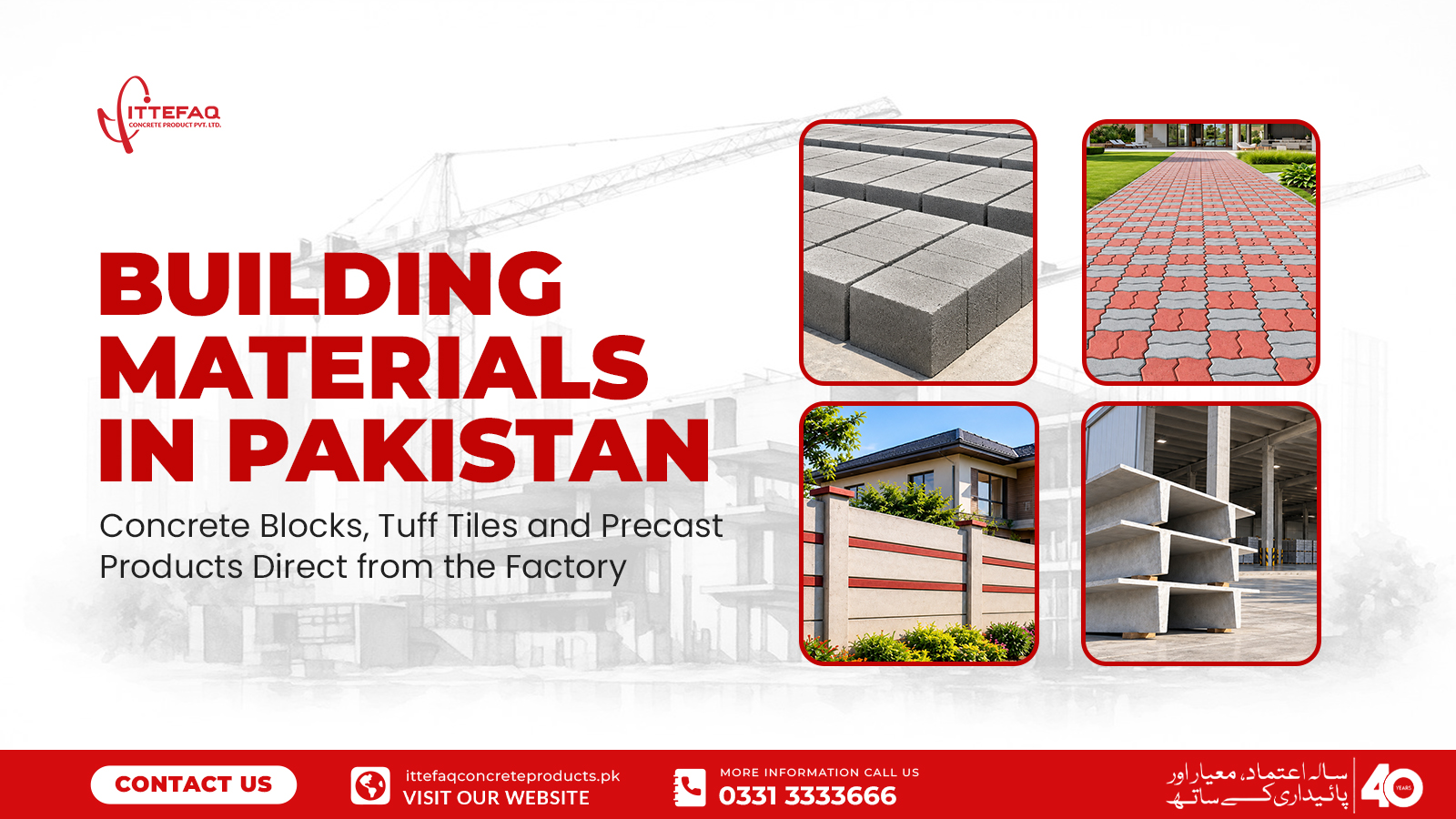
Building materials are everything a project is built from: blocks for the walls, tuff tiles for the driveway, a roof, and a boundary wall around the plot. In Pakistan, more builders now use precast concrete for these jobs because factory-made parts are uniform in size and quicker to install than work cast on site.
This guide explains the main concrete building materials, what each one is used for and what it costs in 2026. It is written by Ittefaq Concrete Products (ICP), a building materials supplier that has made precast concrete products in Pakistan since 1986.
Which Building Materials Does Your Project Need?
Most projects need materials for four parts of the build. Here is how the main concrete products fit in.
| Part of the build | Building material | Where it’s used |
| Walls | Solid concrete blocks | Load-bearing walls, foundations, boundary walls |
| Floors and outdoor areas | Concrete pavers (tuff tiles) | Driveways, parking, walkways, petrol pumps, factory yards |
| Roof | Girder slab roofing or Double T roofing | Homes, shops, warehouses, factories |
| Boundary | Precast boundary walls or brick boundary walls | Homes, farmhouses, schools, factories |
Cement, steel and sand are also construction materials, but you buy them separately. This guide covers the precast concrete products that replace slow on-site work.
Concrete Blocks
Concrete blocks are solid units made from cement, sand and aggregate, then pressed and cured in a factory. Because every block is the same size, walls go up straighter and faster, with less plaster needed to fix uneven lines.
Where concrete blocks are used:
- Load-bearing walls in houses and commercial buildings
- Boundary walls and compound walls
- Foundations and plinth work
- Factory and warehouse walls
Why builders choose solid blocks: they are dense, so they carry heavy loads and resist heat, rain and fire. The solid mass also helps keep sound and heat out.
Concrete Block Price in Pakistan
Concrete block prices depend on size, strength and the quantity you order. Published market rates in 2026 look like this:
| Block type | Size (inches) | Market price per block |
| Solid block | 12 × 8 × 4 | about Rs. 70 to Rs. 100 |
| Hollow block | 16 × 8 × 4 | about Rs. 95 to Rs. 130 |
| Hollow block | 16 × 8 × 8 | about Rs. 180 to Rs. 220 |
Source: Civil Construction Guide, listed as indicative rates. Delivery is usually extra. For a factory price on bulk orders, request a quote from ICP.
Cheap blocks often save money now and cost more later. Ask for the block’s strength and check that sizes are uniform before you buy.
Tuff Tiles (Concrete Pavers)
Tuff tiles, also called concrete pavers, are thick interlocking concrete tiles laid on a sand bed. They carry foot traffic and vehicles, and if one breaks, you can lift and replace just that tile.
They are the most common choice in Pakistan for driveways, car porches, parking areas, footpaths, petrol pumps and factory yards.
Tuff Tile Design in Pakistan
The design of a tuff tile is its shape and colour. The shape affects both the look and how well the tiles lock together. ICP makes three popular shapes:
- Uni: a wavy interlocking shape that holds well under vehicles
- Rectangle: a clean, brick-like look for walkways and porches
- I-section: a strong interlocking shape that suits parking and heavy traffic
Grey is the standard colour. Red and black are popular for borders and patterns, such as a red edge around a grey driveway.
Which Thickness Do You Need?
ICP’s concrete pavers come in two thicknesses:
| Thickness | Usually used for |
| 60 mm | Walkways, lawns, house porches, light traffic |
| 80 mm | Driveways, commercial parking, petrol pumps, industrial yards |
If trucks or heavy vehicles will use the area, choose 80 mm. Ask your concrete contractor to prepare a firm, level base, because the base matters as much as the tile.
Tuff Tiles Price in Pakistan
Tuff tiles are sold either per tile or per square foot, which is why prices online often look confusing. Always check which unit a quote uses.
| How it’s priced | Type | Market price (2026) |
| Per tile | 60 mm grey | about Rs. 49 to Rs. 60 |
| Per tile | 60 mm red or black | about Rs. 53 to Rs. 70 |
| Per tile | 80 mm grey | about Rs. 80 to Rs. 95 |
| Per tile | 80 mm red | about Rs. 85 to Rs. 105 |
| Per sq ft | Plain | about Rs. 70 to Rs. 120 |
| Per sq ft | Interlocking | about Rs. 80 to Rs. 150 |
| Per sq ft | Coloured | about Rs. 100 to Rs. 200 |
Source: Priceinfo, June 2026. Laying, sand, and delivery are usually extra. ICP sells concrete pavers at factory prices with delivery in Punjab, so ask for a quote for your area in square feet.
Precast Roofing Systems
A traditional concrete roof needs shuttering, steel work, pouring and weeks of curing on site. Precast roofing replaces most of that with parts made in a factory, which arrive ready to install.
Girder Slab Roofing
Girder slab roofing uses reinforced precast girders with slab units placed between them. The parts fit together on site, so you need less shuttering, less labour and less curing time. It suits homes, shops and small warehouses. See girder slab roofing.
Double T Roofing
Double T units are large precast slabs shaped like two letter Ts side by side. ICP’s Double T roofing spans up to 15 to 20 metres, with a compressive strength of 35 to 40 MPa. Longer spans mean fewer columns, so you get more open floor space. It suits warehouses, factories and large commercial buildings. See Double T roofing.
Boundary Walls
A boundary wall is often the first thing built on a plot. Precast options go up much faster than brick laid by hand.
- Precast boundary walls: factory-made panels slot into precast posts. They give a clean, modern look and need little maintenance. They suit factories, farmhouses, schools and homes.
- Brick boundary walls: precast walls with a classic brick look, made to your height and length.
Both come in different heights and finishes, so share your plot length and height for a quote.
Precast Concrete vs Building on Site
| Precast concrete | Cast or laid on site | |
| Where it’s made | In a factory, under controlled conditions | On site, in open weather |
| Size and finish | Uniform, every piece the same | Depends on labour and conditions |
| Speed | Faster, parts arrive ready | Slower, needs curing time |
| Labour and shuttering | Less | More |
| Best for | Repeated parts: roofs, walls, pavers, blocks | One-off custom shapes |
Precast doesn’t replace every job. Your concrete contractor will still cast foundations and custom parts on site. But for walls, roofs, paving and boundaries, precast concrete usually saves time and gives a more even finish.
How to Choose a Building Materials Supplier
The right building materials supplier saves you money long after the purchase. Before you order, check these points:
- Buy from the factory where you can. Factory-direct prices skip the middleman, and you can ask about the product directly.
- Ask for strength and size details. A good supplier tells you the thickness, strength and dimensions of what you’re buying.
- Check certifications. Look for quality systems such as ISO 9001 and registration with bodies like the Pakistan Engineering Council.
- Confirm delivery. Ask where they deliver, how long it takes and whether unloading is included.
- Get the quote in writing. Check whether it’s per piece, per square foot or per running foot and what’s included.
- Ask to see past work. A visit to a finished driveway or roof tells you more than a brochure.
Why Builders Choose Ittefaq Concrete Products
Ittefaq Concrete Products has made precast concrete building materials since 1986, when it was known as Ittefaq Building Systems. That’s over 40 years of manufacturing experience.
- Factory direct: a main plant near the Sharaqpur Motorway Interchange, Lahore, with plants in Multan and Rahim Yar Khan
- Certified: ISO 9001:2015, with Pakistan Engineering Council, FBR and Lahore Chamber of Commerce credentials
- One supplier for the whole build: blocks, tuff tiles, roofing and boundary walls
- Delivery across Punjab
Learn more about ICP or see our certifications.
Frequently Asked Questions
What are the main building materials used in Pakistan?
The main building materials are cement, steel, sand, bricks or concrete blocks, and roofing materials. For outdoor areas, tuff tiles are the common choice. More builders now use precast concrete for roofs, walls and paving because it is quicker to install.
What is the concrete block price in Pakistan?
Published 2026 market rates put a 12 × 8 × 4 inch solid block at about Rs. 70 to Rs. 100. Hollow blocks of 16 × 8 × 8 inches cost about Rs. 180 to Rs. 220. Prices change with size, strength and order quantity.
What is the tuff tile price in Pakistan?
In 2026, a 60 mm grey tuff tile costs about Rs. 49 to Rs. 60 per tile, and an 80 mm grey tile costs about Rs. 80 to Rs. 95. Per square foot, plain tuff tiles cost about Rs. 70 to Rs. 120.
Which tuff tile thickness is best for a driveway?
80 mm is the safer choice for driveways and parking, especially for heavy vehicles. 60 mm works for walkways, lawns and light traffic.
Is precast concrete as strong as concrete cast on site?
Precast concrete is made and cured in a factory, so its strength is more consistent. ICP’s Double T roofing, for example, is made at 35 to 40 MPa.
Does ICP deliver building materials?
Yes. ICP delivers across Punjab and has plants near Lahore, in Multan and in Rahim Yar Khan. Share your location and quantity for a delivered price.
Get a Factory Price for Your Project
Please tell us what you’re building, the quantity you need and your location. We’ll send a quote for building materials directly from the factory.
Request a quote or call/WhatsApp +92 331 3333 666
Factory: 1 km from Sharaqpur Motorway Interchange, Stop Nazir Labana, Lahore
Market prices checked in November 2026. They change often, so confirm with the supplier before you order.
